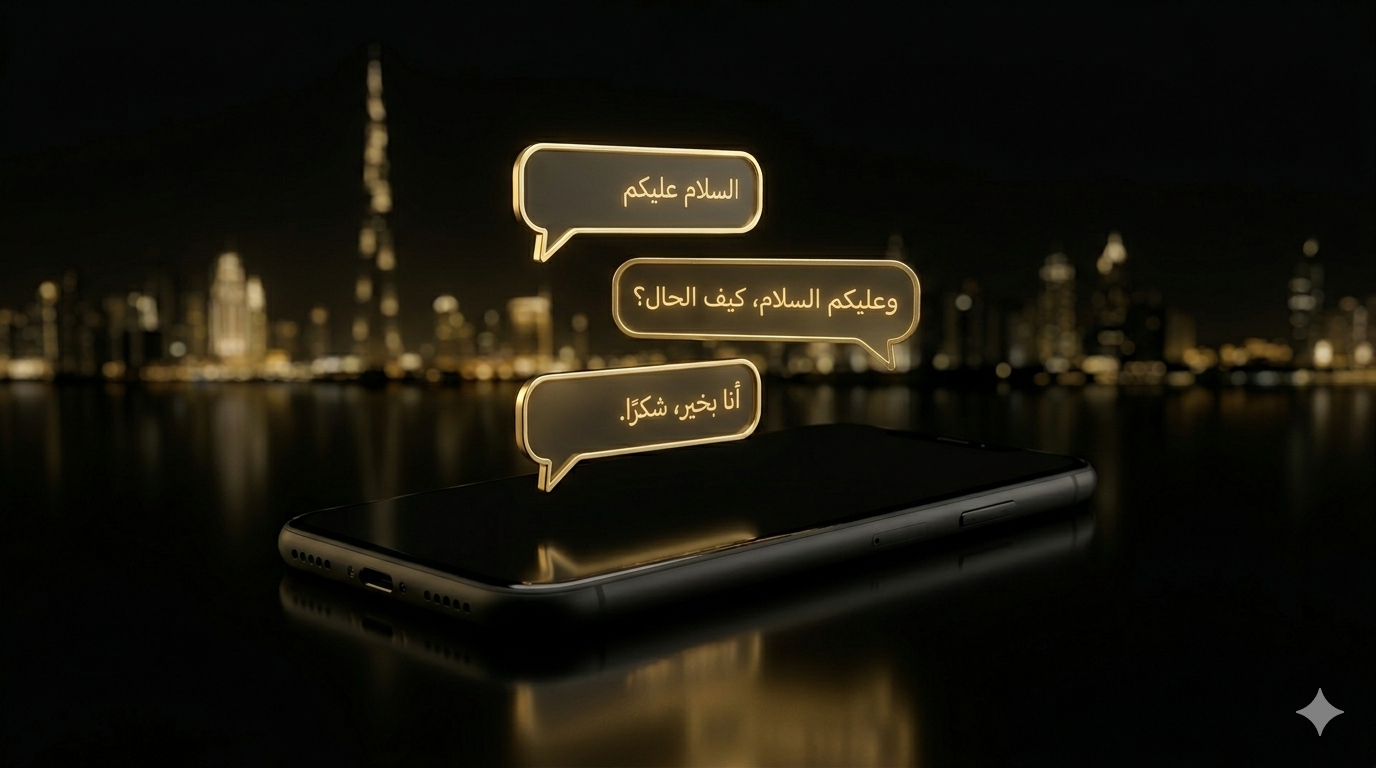
Quick Answer: An Arabic WhatsApp chatbot in the UAE only works if it is built on an AI model that understands Gulf dialect, Arabizi, and English-Arabic code-switching — not just Modern Standard Arabic keywords. Flow-based bots (Manychat, Wati) handle scripted Arabic menus but break on the first real message. A proper bilingual AI chatbot costs AED 5,000 to AED 8,000 setup and AED 1,500 to AED 3,000 per month, with no separate fee for Arabic. The test before you buy: message it in dialect, in Arabizi, and in mixed Arabic-English, and see if it answers naturally in all three.
It is 9pm in Dubai. A customer messages your business on WhatsApp: بكام الشقة وفيه واتساب نتواصل عليه؟ Your shiny new "Arabic-enabled" chatbot replies in English with a menu of four buttons, none of which match what she asked. She leaves. By the time your team sees the message tomorrow morning, she has already booked a viewing with the agency that answered her in seconds — in her own words.
This is the gap nobody selling chatbots in the UAE talks about honestly. Most "Arabic chatbots" on the market support the letters of Arabic, not the language people actually message in. If your customers write in Gulf dialect — and in the UAE most of them do — an Arabic WhatsApp chatbot that only recognises formal Arabic keywords is worse than no chatbot at all, because it answers wrongly and confidently. This guide explains what separates an Arabic chatbot that works from one that quietly loses you leads, with real 2026 AED pricing.
Why Most "Arabic Chatbots" in the UAE Fail the First Real Message
The UAE inbox is multilingual in a way few markets are. Roughly nine in ten adults use WhatsApp, and your customers are Emirati, Egyptian, Levantine, Khaleeji, South Asian, and European — often messaging the same business within the same hour. The Arabic they type almost never matches the Arabic a basic chatbot expects.
Modern Standard Arabic vs Gulf (Khaleeji) Dialect
Modern Standard Arabic (MSA) is the formal Arabic of newspapers, contracts, and government documents. It is also the only Arabic most cheap chatbots are configured for. The problem: nobody messages a flower shop or a real estate agency in MSA. They write the way they speak.
"How much?" in MSA is كم السعر؟. In Gulf dialect a customer types بكام؟ or كم يسوى؟. "Where are you located?" becomes وين مكانكم؟ instead of the textbook أين موقعكم؟. A keyword bot looking for the MSA phrase sees none of its trigger words and either defaults to a generic fallback or guesses wrong.
Arabizi and English-Arabic Code-Switching
Then there is Arabizi — Arabic written in Latin letters with numbers standing in for sounds, like "el sha2a bkam?" or "fee 3andkom tawseel?" A huge share of younger UAE customers default to it on a phone keyboard. And many messages mix languages outright: "Hi, عندكم availability this weekend?" A scripted bot has no path for any of this. A capable AI model reads all three — dialect, Arabizi, and code-switching — as easily as a bilingual human employee would.
This is the core insight: the question is not "does it support Arabic?" Every vendor will say yes. The real question is "does it understand the Arabic my customers actually type?" Those are completely different things.
What an Arabic WhatsApp Chatbot Actually Needs to Handle
Before you evaluate any provider, here is the checklist of what a genuinely Arabic-capable WhatsApp chatbot must do in the UAE market:
- Understand Gulf and Levantine dialect, not just MSA — and reply in the same register the customer used.
- Read Arabizi and respond appropriately, usually in clean Arabic script or matching the customer's style.
- Handle code-switching within a single message and across a conversation.
- Mirror the language automatically — Arabic in, Arabic out; no asking the customer to "press 1 for Arabic."
- Render right-to-left correctly, with Arabic text, numerals, and prices displaying cleanly on WhatsApp.
- Answer off-script questions using your actual business information, not a fixed menu.
- Hand off to a human gracefully when a question is sensitive or out of scope.
Only the last two require careful build work regardless of language. The first five are exactly where flow-based tools fall down and AI-powered tools succeed. If your customer base writes in Arabic, this checklist should decide your purchase — not the price tag.
Flow-Based vs AI-Powered Arabic Chatbots: An Honest Comparison
There are two real options for an Arabic chatbot in the UAE, and the gap between them is widest precisely on the Arabic dimensions. Here is how they compare on what matters.
The honest takeaway: if your customers genuinely write to you in Arabic, a flow bot is a false economy. You save a few thousand dirhams up front and pay for it in conversations that go nowhere. An AI-powered WhatsApp chatbot is the only option that holds up in a real UAE inbox.
Real AED Pricing for an Arabic WhatsApp Chatbot in 2026
One thing to clear up immediately: there is no "Arabic surcharge." Modern AI models handle Arabic natively, so you are not buying a separate language pack. Pricing tracks capability, not language:
- Bilingual AI chatbot (FAQ, lead capture, booking): AED 5,000 – 8,000 setup, AED 1,500 – 3,000/month.
- Custom AI agent (CRM integration, takes actions in Arabic and English): AED 8,000 – 15,000 setup, AED 3,000 – 5,000/month.
Where Arabic does affect the build is testing time. A responsible provider will run your bot through dialect, Arabizi, and mixed-language messages before launch and tune the prompt until it answers naturally in each. That tuning is part of the setup cost, not an add-on. For the full breakdown across all chatbot tiers, see our WhatsApp chatbot pricing guide for Dubai, and for the wider picture our AI automation cost guide.
The Details That Signal a Bot Was Actually Built for Arabic
Beyond understanding the language, small details tell your Arabic-speaking customers whether your business respects their language or bolted it on as an afterthought:
Right-to-left rendering. Arabic text and any mixed numbers should align right and read naturally. Broken RTL — where prices or English words scramble the line — instantly reads as cheap.
Tone and register. Gulf business Arabic has its own warmth and politeness. A bot that replies in stiff, translated-sounding MSA feels robotic. A well-tuned one sounds like a courteous Emirati or Levantine colleague.
Names and pricing kept readable. Customer names, AED figures, and dates should never get mangled when the conversation switches direction. This is a build-quality issue, and it is exactly the kind of thing you only catch by testing.
Test the Arabic Yourself Before You Commit
You should never buy an Arabic chatbot on a vendor's word. Test it. The fastest way to judge any provider is to send their demo three messages: one in Gulf dialect, one in Arabizi, and one mixing Arabic and English — then read whether the replies sound human in each.
You can do exactly that with our live AI demo. Pick a sector, message the agent in whatever Arabic your customers use, and watch it respond. It is the same engine we deploy for clients — try to break it, then judge for yourself. If you would rather talk through your specific use case, a custom AI agent can be trained on your products, pricing, and policies in both languages.
Frequently Asked Questions
Can a WhatsApp chatbot in the UAE understand Gulf Arabic dialect?
Yes, but only AI-powered chatbots built on large language models like GPT-4 or Claude handle Gulf (Khaleeji) dialect reliably. They understand Modern Standard Arabic, Khaleeji and Egyptian dialects, Arabizi (Arabic written in Latin letters and numbers), and English-Arabic code-switching in the same message. Flow-based bots like Manychat and Wati only match pre-set Arabic keywords and break the moment a customer writes off-script — which in real UAE inboxes is almost immediately.
What is the difference between Modern Standard Arabic and the Arabic people actually message in?
Modern Standard Arabic (MSA) is the formal written Arabic used in newspapers and official documents. Almost no one messages a business in MSA. UAE customers write in Gulf or Levantine dialect, often mix in English words, and frequently type Arabizi — for example "el shaqqa bkam?" instead of the proper Arabic script. A chatbot trained only on MSA keywords will miss most real messages. This is the single biggest reason Arabic chatbots fail in the UAE.
How much does an Arabic WhatsApp chatbot cost in the UAE in 2026?
A bilingual Arabic and English AI chatbot in the UAE costs AED 5,000 to AED 8,000 for setup and AED 1,500 to AED 3,000 per month in 2026. Add CRM integration or booking actions and you move into the AED 8,000 to AED 15,000 setup range. There is no extra licence fee for Arabic itself — modern AI models handle it natively. The cost difference versus an English-only bot comes from testing and tuning across dialects, not from a separate language module.
Do Manychat and Wati support Arabic for WhatsApp?
They support Arabic text and right-to-left display for scripted, button-based flows — sending an Arabic menu or a fixed Arabic reply works fine. What they cannot do is hold a natural Arabic conversation, understand dialect or Arabizi, or answer an unexpected question. For a business whose customers write freely in Arabic, a flow bot will frustrate them on the first message that does not match a button. For genuine Arabic conversation you need an AI-powered chatbot.
Will an Arabic chatbot reply in the same language the customer used?
A well-built AI chatbot detects the language of each message and mirrors it — Arabic in, Arabic out; English in, English out; and it can handle a customer who switches mid-conversation. It should also render Arabic right-to-left, use the correct numerals, and keep names and prices readable. Always test this before you buy: send the bot a Gulf-dialect message, an Arabizi message, and a mixed English-Arabic message and see whether it answers naturally in each.