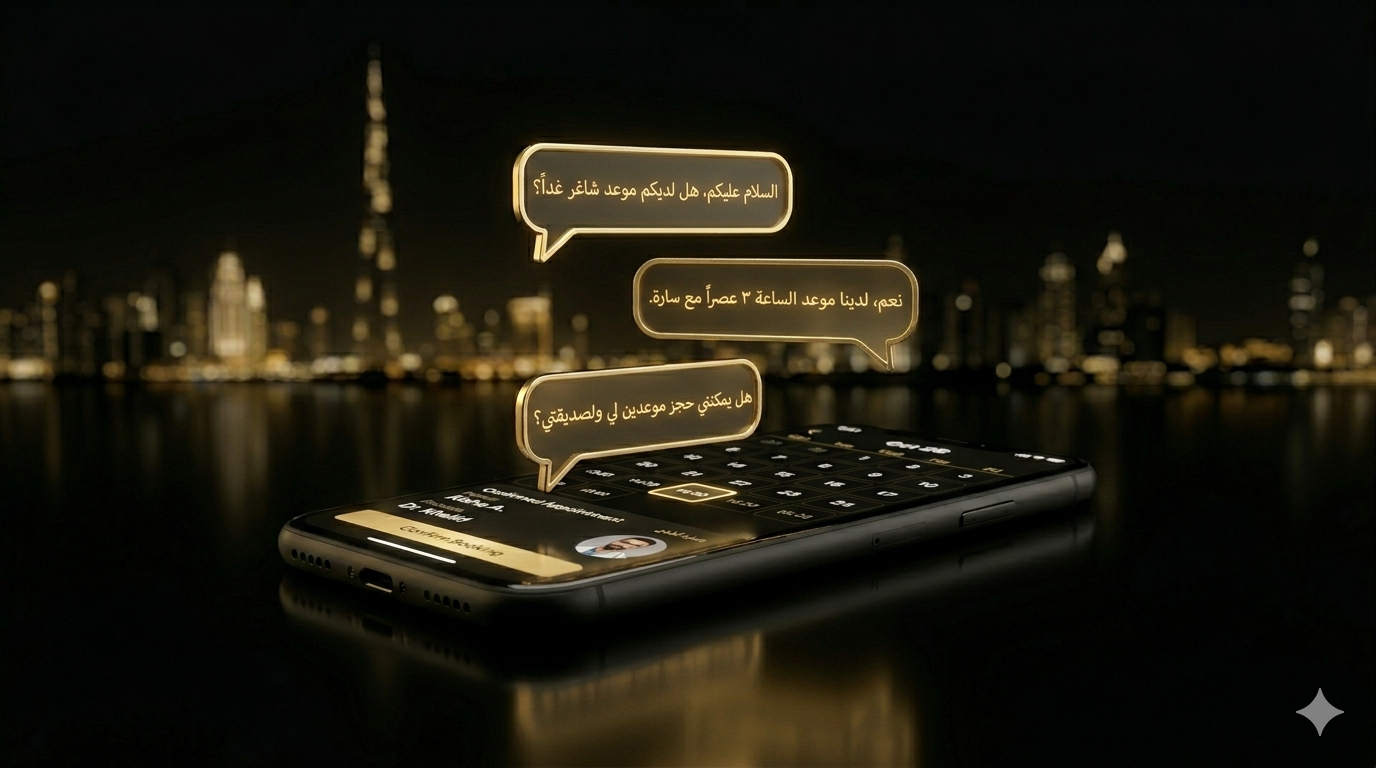
Quick Answer: A WhatsApp AI chatbot lets a Dubai clinic book appointments 24/7, send reminders that cut no-shows, and answer routine patient questions in Arabic and English — without adding reception staff. UAE clinics run 15 to 30 percent no-show rates; a clinic seeing 200 appointments a week at AED 500 each can recover over AED 1 million a year by halving that. Setup costs AED 6,000 to AED 15,000 with AED 2,000 to AED 4,000 monthly. The chatbot handles admin only — anything clinical is routed to your team, in line with DHA and MOHAP rules.
It's a Tuesday afternoon at a clinic in Jumeirah. The reception phone has rung eleven times in the last hour, mostly during the lunch break when two of the three front-desk staff are out. Four calls went unanswered. Meanwhile, a 4pm patient just didn't show — an empty AED 500 slot that could have gone to someone on the waitlist, if anyone had thought to message them. None of this is a staffing failure. It's a structural one: patients now expect to book and ask questions on WhatsApp, instantly, and a human reception desk physically cannot be in three conversations at once.
This is the exact gap an AI chatbot for clinics in Dubai closes. Not by replacing your reception team, but by handling the high-volume, repetitive contact — booking, reminders, directions, refill requests — so your staff can focus on patients in front of them. This guide covers what a healthcare WhatsApp chatbot actually does, the no-show math that makes it pay for itself, real 2026 AED pricing, and the compliance boundaries you must insist on.
The Real Cost of No-Shows for a UAE Clinic
No-shows are the most expensive problem most clinics never put a number on. Across the UAE, clinics commonly run no-show rates between 15 and 30 percent. Every missed appointment is a slot that earned nothing, plus the downstream cost of a longer waitlist and frustrated patients who couldn't get in.
Put real numbers on it. A clinic seeing 200 appointments a week, at an average value of AED 500, with a 20 percent no-show rate, is losing 40 appointments a week — AED 20,000 — to empty chairs. Cut that to 10 percent and you recover roughly AED 10,000 a week, which is over AED 500,000 a year from reminders alone. Clinics with higher appointment values or volumes recover well past AED 1 million annually.
The reason a WhatsApp reminder works where an SMS or a phone call doesn't: it's in the channel patients already live in, and it lets them confirm, reschedule, or cancel in one tap. A cancellation isn't a loss — it's a freed slot the chatbot can immediately offer to the next patient. That single workflow is usually enough to justify the entire system.
What a Healthcare WhatsApp Chatbot Actually Does
A clinic chatbot is not a symptom-checker and it is not a doctor. It is an always-on front desk for the administrative work that swamps your reception team. Here is the realistic scope.
24/7 Appointment Booking on WhatsApp
Patients message at the times they're free — evenings, weekends, during their own work breaks. An AI chatbot takes the booking conversation end to end: which doctor or service, preferred day and time, new or returning patient, and confirmation — then writes it straight into your booking system or calendar. No missed call, no callback, no slot left unfilled because the desk was busy.
Automated Reminders That Cut No-Shows
The chatbot sends a reminder 24 to 48 hours ahead with one-tap confirm, reschedule, or cancel. Confirmed patients show up. Cancelled slots get reopened automatically. This is the single highest-ROI function and, on its own, typically pays for the system within the first quarter.
Prescription Refills and Routine Queries
"Are you open on Saturday?" "Do you take Daman insurance?" "Where do I park?" "Can I get a refill on my prescription?" These questions consume hours of reception time every week and have fixed answers. The chatbot resolves them instantly in Arabic or English, and forwards a refill request to the right person to action. Studies of UAE deployments put routine inquiries the chatbot can fully handle at 60 to 80 percent of inbound volume.
Routing Anything Clinical to a Human
The moment a conversation turns clinical — symptoms, results, anything requiring judgement — the chatbot hands off to a qualified staff member rather than improvising. This boundary is not a limitation; it is the design. It keeps patients safe and keeps you on the right side of the regulator.
Compliance: What You Must Insist On
Healthcare is regulated, and a chatbot touching patient contact has to respect that. UAE clinics fall under the Dubai Health Authority (DHA), MOHAP, or Abu Dhabi's ADHICS framework depending on emirate, alongside federal data-protection law. A responsible build follows three principles:
- Administrative scope only. No diagnosis, no treatment advice, no interpreting symptoms or results. Clinical matters go to licensed staff, always.
- Data minimisation. The chatbot collects only what's needed to book or manage an appointment — not full medical histories over WhatsApp.
- Secure, accountable storage. You should know exactly where patient data sits, who can access it, and how it's protected before launch.
Any provider who waves away these questions or promises a bot that "diagnoses patients" is a provider to walk away from. Compliance is part of the build, not a box ticked afterwards.
Manual Reception vs an AI Chatbot: An Honest Comparison
This isn't about removing your team — it's about what each is actually good at. Here's where the chatbot earns its place.
The point of the table isn't that the chatbot wins every row — it's that the chatbot absorbs the repetitive volume so your reception team can spend its time on patients who need a human. A WhatsApp AI chatbot and a good front desk are complements, not substitutes.
Real AED Pricing for a Clinic Chatbot in Dubai
Pricing tracks how much the chatbot needs to integrate with your systems:
- Booking, reminders, and FAQ (standalone or calendar-linked): AED 6,000 – 9,000 setup, AED 2,000 – 3,000/month.
- Integrated with your booking system or EMR, plus refill routing: AED 9,000 – 15,000 setup, AED 3,000 – 4,000/month.
Compare that against a single additional reception hire — roughly AED 10,000 a month fully loaded in the UAE, working one shift, in one language, never after hours. The chatbot covers every hour in both languages for a fraction of that. For the full cross-service breakdown, see our AI automation cost guide for Dubai, and for how clinics fit a broader automation rollout, our healthcare automation page. Connecting the chatbot to your calendar, CRM, or EMR is an automation pipeline job, and the value compounds once bookings flow automatically into the systems you already use.
Try It Against Your Own Questions
Don't take the description on trust — test it. Our live AI demo lets you talk to a real AI agent the way a patient would: ask about availability, try to book, switch to Arabic mid-sentence, and see how it responds. It's the same engine we deploy for clients. If you'd like it trained specifically on your services, doctors, and policies, that's a custom AI agent built around your clinic.
Frequently Asked Questions
How much does an AI chatbot for a clinic cost in Dubai in 2026?
A WhatsApp AI chatbot for a Dubai clinic costs AED 6,000 to AED 15,000 for setup and AED 2,000 to AED 4,000 per month in 2026. The lower end covers appointment booking, reminders, and FAQ handling in Arabic and English. The higher end adds integration with your booking system or EMR, prescription refill requests, and routing to the right department. Most single-location clinics land around AED 9,000 setup and AED 2,800 monthly.
Can a chatbot really reduce patient no-shows at a UAE clinic?
Yes. UAE clinics typically see 15 to 30 percent no-show rates, and automated WhatsApp reminders with easy reschedule and confirm options reliably cut that. A clinic seeing 200 appointments a week at an average AED 500 that reduces no-shows from 20 percent to 10 percent recovers roughly AED 20,000 per week, or over AED 1 million a year. The reminder works because it lets the patient confirm, reschedule, or cancel in one tap — which also frees the slot for someone else.
Is a healthcare chatbot allowed to give medical advice or diagnose patients?
No, and it should not try. A well-designed clinic chatbot handles administrative tasks — booking, reminders, directions, opening hours, prescription refill requests, and general service questions — and routes anything clinical to a qualified staff member. It should never diagnose, recommend treatment, or interpret symptoms. This is both a patient-safety boundary and a regulatory one under DHA and MOHAP rules. The chatbot's job is to save your reception team time, not to practise medicine.
Does a clinic WhatsApp chatbot comply with DHA and UAE data rules?
It can, if it is built correctly. The chatbot should collect only the minimum information needed to book or manage an appointment, store patient data securely, and keep clinical conversations with licensed staff. UAE clinics fall under Dubai Health Authority (DHA), MOHAP, or Abu Dhabi's ADHICS framework depending on emirate, plus federal data-protection law. A responsible provider will design the data flow around these requirements rather than treating compliance as an afterthought. Confirm where patient data is stored and who can access it before you sign.
Can the chatbot handle Arabic-speaking patients?
Yes. An AI-powered chatbot built on models like GPT-4 or Claude handles Modern Standard Arabic, Gulf and Levantine dialects, and English, switching to match each patient automatically. This matters in the UAE, where patients message in whichever language is most comfortable, often mixing both. Flow-based booking bots that only fire on fixed keywords struggle here — see our guide to Arabic WhatsApp chatbots in the UAE for why AI-powered bots are the better fit for a multilingual patient base.